
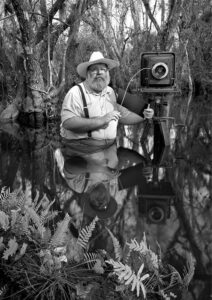
Clyde Butcher: Seeing the World Through Silver and Patience
As someone who’s spent years behind film cameras, I’ve always felt a quiet kinship with Clyde Butcher. There’s something about the way he works — the patience, the scale, the devotion to process — that speaks directly to what drew me to film in the first place. His photographs aren’t just images; they’re meditations.
From Architecture to the Swamp
Butcher’s story has always fascinated me. He started out in architecture — and you can see it in his work. Every line and shadow is deliberate. Even when he’s knee-deep in a Florida swamp, his compositions carry that architectural sense of balance and structure.
Like a lot of us, he began shooting commercially, making a living however he could. Early on, he sold colorful landscape prints at art fairs. They were well done, but you could tell he was still searching for something more — something that couldn’t be captured with quick color shots or mass-market frames.
Then life handed him a kind of tragedy that changes everything. After his son died in a car accident in 1986, he turned inward — and found his way back to black-and-white film, large-format cameras, and the quiet wild of Florida. That’s where his real voice emerged.
The Craft That Can’t Be Rushed
If you’ve ever wrestled with a large-format camera, you know what kind of patience it demands. Clyde doesn’t chase the shot; he waits for it. He moves slowly, sometimes spending hours or even days wading through the swamp just to catch the right light breaking through the cypress.
His prints are enormous — big enough to walk into. You can almost smell the damp air, hear the insects, feel the stillness. And the tonal control… it’s masterful. Every gradation of gray feels intentional, carved out of silver and light. You can tell he’s spent a lifetime inside the darkroom, coaxing detail out of shadows instead of relying on a histogram or preset.
That’s the thing I love most about his work: it reminds us what film can do that digital still can’t. It slows us down. It rewards patience. It asks us to look deeply.
The Spirit of the Place
What makes Clyde’s work so moving isn’t just the technical mastery — it’s his relationship with the land. Most photographers chase the dramatic: mountains, storms, sunsets. But Clyde fell in love with flat, watery, chaotic places — swamps, wetlands, rivers that snake quietly through the landscape.
He somehow finds structure and peace in that chaos. His compositions lead your eye through tangled trees and reflections until you start to see what he sees: a sacred stillness in places most people would just drive past.
It’s no accident he’s become one of Florida’s strongest advocates for conservation. His photos make people care — not because they lecture, but because they move you.
Why He Matters
Clyde Butcher reminds me what drew me to film in the first place: the discipline, the intimacy, the reverence for craft. His work proves that photography, at its best, isn’t about the camera or the trend — it’s about connection. Between the photographer and the place, between patience and light, between what’s seen and what’s felt.
He’s shown generations of photographers that the quiet places matter just as much as the grand ones, and that the old ways of making images — film, chemistry, time — still hold something sacred.
In an era of fast images and fleeting attention, Clyde stands as a reminder that slowing down is not a step backward. It’s how we learn to truly see.
Visit his site here: https://clydebutcher.com/artists/clyde/bio